Among the following fatty acids, which group is known as essential fatty acids?
A. 9,11-Octadecadienoic and 9,11,13-Octadecatrienoic
B. 9,12-Octadecadienoic and 9,12,15-Octadecatrienoic correct
C. 9-Octadecenoic and 9,11-Octadecadienoic
D. 9,11-Octadecadienoic and 9-Eicosenoic
Q2MCQ1 mark
Cellulose, the structural polysaccharide of plant, is a polymer of
A. β-D-Glucose correct
B. α-D-Glucose
C. β-D-Galactose
D. α-D-Galcturonic acid
Q3MCQ1 mark
The important role of carotenoids in the human diet is their ability to serve as precursors of
A. Vitamin C
B. Vitamin D
C. Vitamin A correct
D. Vitamin K
Q4MCQ1 mark
Which one of the following microorganisms is used in the preparation of bread?
A. Candida utilis
B. Saccharomyces cerevisiae correct
C. Saccharomyces cevarum
D. Aspergilus niger
Q5MCQ1 mark
Which one of the microorganisms given below is NOT RESPONSIBLE for ropy or stringy fermentation of milk?
A. Alcaligenes viscolactis
B. Enterobacter aerogenes
C. Streptococcus cremoris
D. Streptococcus lactis correct
Q6MCQ1 mark
A mild heat treatment of foods that destroys pathogens and extends its shelf life is called
A. Baking
B. Blanching
C. Sterilization
D. Pasteurization correct
Q7MCQ1 mark
The most common and least expensive plastic film used for packaging of solid food materials is
A. Polyethylene correct
B. Polystyrene
C. Polypropylene
D. Polyvinylchloride
Q8MCQ1 mark
Reassociation of amylose and formation of crystalline structure upon cooling of cooked starch solution is termed as
A. Synersis
B. Gelatinization
C. Retrogradation correct
D. Denaturation
Q9MCQ1 mark
Thermal destruction of microorganisms follows a kinetics of
A. Zero order
B. First order correct
C. Second order
D. Fractional order
Q10MCQ2 marks
Which one of the following is NOT A CORRECT statement?
A. Meatiness is the taste produced by compounds such as glutamate in products like cheese, soy sauce.
B. Astringency is a dry mouth feel in the oral cavity that is most associated with phenolic compounds.
C. Saltiness is a taste that is mainly produced by chloride ions. correct
D. Sourness is related to acidity and is sensed by hydrogen ion channels in the human tongue.
Q11MCQ2 marks
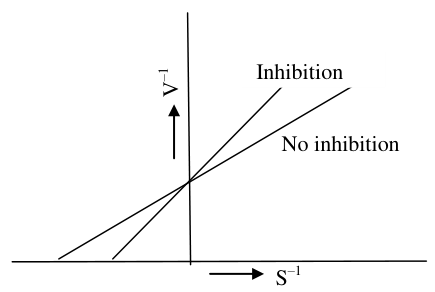
The following plot represents the Lineweaver-Burk equation of an enzymatic reaction both in the presence and the absence of inhibitor. Here, V is the velocity of reaction and S is the substrate concentration.
The nature of inhibition shown in the plot is
A. Non-competitive
B. Anti-competitive
C. Competitive correct
D. Mixed type
Q12MCQ2 marks
Make the correct match of the food constituents in Group I with their nature given in Group II.
Group I | Group II
P) Ascorbic Acid | 1) Sugar
Q) Phenyl alanine | 2) Chelate
R) Dextrose | 3) Amino Acid
S) Haemoglobin | 4) Antioxidant
A. P-4, Q-3, R-1, S-2 correct
B. P-4, Q-1, R-3, S-2
C. P-3, Q-4, R-2, S-1
D. P-4, Q-2, R-1, S-3
Q13MCQ2 marks
Make the correct match of the fermented food products in Group I with the microorganisms in Group II.
Group I | Group II
P) Yoghurt | 1) Lactobacillus acidophilus and Lactobacillus delbrueckii
Q) Cheese | 2) Leuconostoc mesenteroides and Lactobacillus plantarum
R) Sauerkraut | 3) Lactobacillus delbrueckii and Streptococcus thermophillus
S) Kefir | 4) Lactobacillus casei and Streptococcus thermophillus
A. P-1, Q-4, R-2, S-3
B. P-4, Q-3, R-1, S-2
C. P-3, Q-4, R-2, S-1 correct
D. P-3, Q-2, R-4, S-1
Q14MCQ2 marks
Match the following between organelle or cellular components of a bacterium cell in Group I with the constituents and functionalities in Group II.
Group I | Group II
P) Cytoplasmic membrane | 1) Protein synthesis
Q) Flagellum | 2) Peptidoglycan
R) Cell wall | 3) Phospholipid bilayer
S) Ribosome | 4) Motility of cell
A. P-3, Q-2, R-4, S-1
B. P-4, Q-2, R-1, S-3
C. P-3, Q-4, R-2, S-1 correct
D. P-2, Q-3, R-4, S-1
Q15MCQ2 marks
Thermal death time (TDT) of Clostridium botulinum at 121 °C is 2.78 min with a z-value of 10 °C. The TDT of the microorganism at 116 °C (in min) is
A. 5.270
B. 8.791 correct
C. 1.390
D. 0.712
Q16MCQ2 marks
Make the correct match between specific food processing operations in Group I with their mechanism of action in Group II.
Group I | Group II
P) Ball Mill | 1) Compression and shear
Q) Roller Mill | 2) Pressure bursting
R) Flash Peeling | 3) Friction and shear
S) Abrasive Peeling | 4) Impact and shear
A. P-4, Q-2, R-1, S-3
B. P-4, Q-1, R-2, S-3 correct
C. P-4, Q-3, R-2, S-1
D. P-3, Q-1, R-4, S-2
Q17MCQ2 marks
Common Data for Questions 17 and 18:
650 g of a wet food containing 405 g water is dried in a tray dryer to a final moisture content of 6.8 % (dry basis). It is observed that the drying process occurs under constant rate period and it takes 8 h.
Initial moisture content (in percentage) of the food on wet basis is
A. 62.31 correct
B. 70.45
C. 162.31
D. 165.31
Q18MCQ2 marks
Common Data for Questions 17 and 18:
650 g of a wet food containing 405 g water is dried in a tray dryer to a final moisture content of 6.8 % (dry basis). It is observed that the drying process occurs under constant rate period and it takes 8 h.
The rate of drying (in kg/h) is
A. 128.79
B. 126.35
C. 77.81
D. 0.0485 correct
Q19MCQ2 marks
Common Data for Questions 19 and 20:
Air at 1 atmospheric pressure (101.325 kPa) and 30 °C with absolute humidity of 0.0218 kg/kg of dry air is flowing in a drying chamber. The saturated vapor pressure of water (pw⁰, in kPa) is related to temperature (T, in °C) as given below
ln pw⁰ = 18.6556 − 5217.635/(T + 273)
Heat capacities of dry air (average molecular weight 29) and that of water vapor (molecular weight 18) are 1.005 and 1.884 kJ/kg.K, respectively. Latent heat of vaporization of water at reference temperature (0 °C) is 2502.3 kJ/kg.
The relative humidity of air (in percentage) is
A. 62.82
B. 68.22
C. 86.62
D. 81.80 correct
Q20MCQ2 marks
Common Data for Questions 19 and 20:
Air at 1 atmospheric pressure (101.325 kPa) and 30 °C with absolute humidity of 0.0218 kg/kg of dry air is flowing in a drying chamber. The saturated vapor pressure of water (pw⁰, in kPa) is related to temperature (T, in °C) as given below
ln pw⁰ = 18.6556 − 5217.635/(T + 273)
Heat capacities of dry air (average molecular weight 29) and that of water vapor (molecular weight 18) are 1.005 and 1.884 kJ/kg.K, respectively. Latent heat of vaporization of water at reference temperature (0 °C) is 2502.3 kJ/kg.
The enthalpy (in kJ/kg) of moist air is
A. 85.93 correct
B. 54.55
C. 31.38
D. 99.38
Q21MCQ2 marks
Linked Answer Questions 21 and 22:
The total solids content in a milk sample is 18 %. It is desired to produce 1000 kg of sweetened condensed milk (SCM) having 40 % sugar, 25 % moisture and rest milk solids.
What is the 'Sugar Ratio' (in percentage) in the SCM in terms of sugar and water content in the final product?
A. 48.19
B. 61.54 correct
C. 54.16
D. 56.14
Q22MCQ2 marks
Linked Answer Questions 21 and 22:
The total solids content in a milk sample is 18 %. It is desired to produce 1000 kg of sweetened condensed milk (SCM) having 40 % sugar, 25 % moisture and rest milk solids.
If the 'Concentration Degree' is 2.5, the amount of sugar added in kg in the milk sample is
A. 246.16 correct
B. 216.64
C. 192.76
D. 224.56
Worked solutions are not printed here — every one of these questions carries a
full explanation inside the test itself, which is where it is actually useful:
after an answer has been committed.
Sit the 2012 paper.