The enzyme majorly involved in postmortem degradation of muscle proteins is
A. Trypsin
B. Calpin correct
C. Transglutaminase
D. Pepsin
Q2MCQ1 mark
Which of the following is the correct pair of essential fatty acids?
A. Oleic acid and Lenoleic acid
B. Lenoleic acid and Linolenic acid correct
C. Linolenic acid and Lauric acid
D. Linolenic acid and Oleic acid
Q3MCQ1 mark
Nisin A is produced by
A. Aspergillus niger
B. Acetobacter aceti
C. Lactobacillus lactis correct
D. Clostridium perfringens
Q4MCQ1 mark
Which of the following bacteria will stain purple color after Gram staining?
A. Bacillus subtilis correct
B. Escherichia coli
C. Pseudomonas aeruginosa
D. Yersinia pestis
Q5MCQ1 mark
The enzyme system used for removal of glucose from egg white prior to its drying consists of
A. Glucose oxidase and Catalase correct
B. Glucosidase and Glucoisomerase
C. Glucoisomerase and Catalase
D. Glucoamylase and Glucose oxidase
Q6MCQ1 mark
The INCORRECT pair of food borne illness and its causative microorganism is
A. Brucellosis – Brucella Sp.
B. Peptic ulcers – Bacillus subtilis correct
C. Bubonic plague - Yersinia pestis
D. Q fever – Coxiella burnatii
Q7MCQ1 mark
Which of the following is commonly used as a preservative in the tomato sauce?
A. Sodium sulphite
B. Potassium sorbate
C. Potassium sulphite
D. Sodium benzoate correct
Q8MCQ1 mark
A fluid with flow behaviour index less than one (n < 1) is
A. Dilatant
B. Pseudoplastic correct
C. Bingham plastic
D. Newtonian
Q9NAT1 mark
The velocity of 2.2 μm diameter fat particles inside a centrifuge, running at 6000 rpm and 20 °C, is 0.25 mm s⁻¹. The velocity of 1.5 μm diameter fat particles inside the same centrifuge running at 7500 rpm and same temperature (round off to 2 decimal places) will be _____ mm s⁻¹.
Correct: 0.15 to 0.21
Q10NAT1 mark
The initial population of a bacterial strain increases from 1×10⁴ cells per mL to 1×10⁶ cells per mL in 120 minutes. The generation time for this strain (round off to 2 decimal places) is _____ minutes.
Correct: 17 to 19
Q11MCQ2 marks
Match the protein in Column I with its food source in Column II.
Column I: P. Zein, Q. Gluten, R. Glycinin, S. Ovalbumin
Column II: 1. Soybean, 2. Maize, 3. Egg, 4. Wheat
A. P-4, Q-1, R-2, S-3
B. P-4, Q-3, R-1, S-2
C. P-2, Q-3, R-1, S-4
D. P-2, Q-4, R-1, S-3 correct
Q12MCQ2 marks
Match the carbohydrate in Column I with corresponding enzyme used for its hydrolysis in Column II.
Column I: P. Pectin, Q. Lactose, R. Hemicellulose, S. Inulin
Column II: 1. Xylanase, 2. β-galactosidase, 3. Polygalacturonase, 4. β-fructofuranosidase
A. P-3, Q-2, R-1, S-4 correct
B. P-2, Q-4, R-1, S-3
C. P-1, Q-2, R-3, S-4
D. P-4, Q-3, R-1, S-2
Q13MCQ2 marks
Match the edible oil refining stage in Column I with its purpose in Column II.
Column I: P. Degumming, Q. Neutralization, R. Bleaching, S. Winterization
Column II: 1. Separation of triglycerides, 2. Removal of pigments, 3. Removal of phosphatides, 4. Removal of free fatty acids
A. P-3, Q-1, R-2, S-4
B. P-1, Q-4, R-2, S-3
C. P-4, Q-3, R-1, S-2
D. P-3, Q-4, R-2, S-1 correct
Q14MCQ2 marks
Match the food material in Column I with its related term in Column II.
Column I: P. Coffee, Q. Cocoa, R. Beer, S. Wine
Column II: 1. Wort, 2. Must, 3. Arabica, 4. Theobroma
A. P-4, Q-2, R-1, S-3
B. P-3, Q-4, R-1, S-2 correct
C. P-3, Q-4, R-2, S-1
D. P-1, Q-3, R-4, S-2
Q15MCQ2 marks
Match the component/system in Column I with the peeling method for fruits and vegetables in Column II.
Column I: P. Lye solution, Q. Carborundum rollers, R. Pressure vessel, S. Conveyor belt
Column II: 1. Flash peeling, 2. Flame peeling, 3. Abrasion peeling, 4. Caustic peeling
A. P-4, Q-3, R-2, S-1
B. P-3, Q-4, R-1, S-2
C. P-4, Q-3, R-1, S-2 correct
D. P-3, Q-4, R-2, S-1
Q16MCQ2 marks
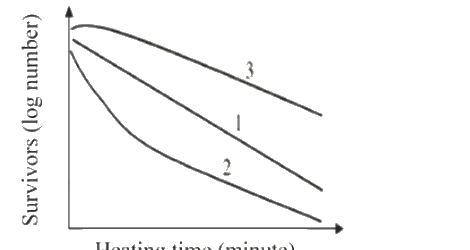
Which among the given options correctly explains the nature of the microbial culture represented by lines 1, 2 and 3 in the following figure?
A. 1. Mixed population, 2. Microorganisms activated by short exposure to heat, 3. Germination of spores
B. 1. Homogeneous population, 2. Mixed population of heat sensitive and heat resistant microbes, 3. Germination of spores correct
C. 1. Composite population, 2. Spores activated by short exposure to heat, 3. Thermo sensitive and thermo resistant microbes
D. 1. Mixed population, 2. Microorganisms activated by short exposure to heat, 3. Germination of spores
Q17MCQ2 marks
Match the equation/law in Column I with its application in Column II.
Column I: P. Plank's equation, Q. Arrhenius equation, R. Guggenheim-Anderson-de Boer equation, S. Stoke's law
Column II: 1. Terminal velocity, 2. Freezing time, 3. Activation energy, 4. Monolayer moisture content
A. P-1, Q-3, R-4, S-2
B. P-2, Q-3, R-1, S-4
C. P-2, Q-3, R-4, S-1 correct
D. P-4, Q-3, R-1, S-2
Q18MCQ2 marks
Match the absorber used in modified atmosphere packaging and storage in Column I with the scavenger in Column II.
Column I: P. Oxygen absorber, Q. Carbon dioxide absorber, R. Ethylene absorber, S. Moisture absorber
Column II: 1. Calcium chloride, 2. Magnesium oxide, 3. Ferric oxide, 4. Potassium permanganate
A. P-3, Q-2, R-4, S-1 correct
B. P-1, Q-2, R-4, S-3
C. P-2, Q-3, R-4, S-1
D. P-3, Q-2, R-1, S-4
Q19MCQ2 marks
During extrusion cooking, food materials are generally subjected to a combination of
A. high shear and low pressure
B. high temperature and high shear correct
C. low shear and high temperature
D. low shear and low pressure
Q20NAT2 marks
An orange juice flowing at 0.80 kg s⁻¹ enters a counter current double pipe heat exchanger at 20 °C and leaves at 72 °C. Inlet and outlet temperatures of the hot water used as heating medium in the exchanger are 81 °C and 74 °C, respectively. The specific heat of the orange juice is 3.74 kJ kg⁻¹ K⁻¹ and overall heat transfer coefficient is 492 W m⁻² K⁻¹. The heat transfer surface area (round off to 2 decimal places) will be _____ m².
Correct: 11 to 14
Worked solutions are not printed here — every one of these questions carries a
full explanation inside the test itself, which is where it is actually useful:
after an answer has been committed.
Sit the 2020 paper.