Indicate the correct group that contains a monosaccharide, a disaccharide and a trisaccharide.
A. Glucose, sucrose, mannose
B. Ribose, lactose, raffinose correct
C. Mannose, maltose, lactose
D. Raffinose, stachyose, glucose
Q97MCQ1 mark
In which of the following products, ‘must’ is used as the substrate for fermentation?
A. Beer
B. Wine correct
C. Idli
D. Tempeh
Q98MCQ1 mark
Identify the foodborne illness which is not caused by bacteria.
A. Botulism
B. Listeriosis
C. Vibriosis
D. Cysticercosis correct
Q99MCQ1 mark
Nutrient composition of wheat flour changes with extent of extraction from whole wheat grain. Which of the following statements is true if the extraction rate increased from 50% to 90%?
A. Starch increases, protein increases, fat increases, mineral increases
B. Starch decreases, protein increases, fat increases, mineral increases correct
C. Starch decreases, protein decreases, fat increases, mineral decreases
D. Starch decreases, protein increases, fat decreases, mineral decreases
Q100NAT1 mark
You have two samples of milk, one (X) with 3.8% fat and another (Y) with 0.5% fat. In order to produce a milk with 3.5% fat, 100 ml of Y should be mixed with _______ ml of X.
Correct: 1000
Q101MCQ1 mark
Match the items in column I with the items in column II in relation to food safety and standards.
Column I
P. HACCP
Q. FSSAI
R. CIP
S. CODEX
Column II
1. International food standards
2. Quality control protocol
3. Food plant sanitation and hygiene protocol
4. Indian food standards
A. P-2, Q-4, R-3, S-1 correct
B. P-4, Q-3, R-2, S-1
C. P-1, Q-4, R-2, S-3
D. P-4, Q-2, R-3, S-1
Q102NAT1 mark
A 50% sucrose solution at 20 °C is flowing at a rate of 3.5 m³/h through a pipe with an inside diameter of 0.0475 m and length of 12 m. The viscosity and the density of the solution are 15.43 cp and 1232 kg/m³, respectively. The Reynolds number of the flow is _______ .
Correct: 2078 to 2086
Q103NAT1 mark
In a pineapple juice, fibre particles having mean diameter of 160 µm and density of 1075 kg/m³ are settling by gravity. If the density and viscosity of the juice are 1015 kg/m³ and 0.98 cp, respectively, terminal velocity of the fibre particles is______ mm/s .
Correct: 0.8 to 0.9
Q104MCQ1 mark
Power consumption in liquid mixing is proportional to __________.
A. Power number × liquid density × (rotational speed)³ × (impeller diameter)⁵ correct
B. Power number × liquid density × (rotational speed)² × (impeller diameter)³
C. Liquid density × viscosity of the liquid × (rotational speed)² × (impeller diameter)³
D. Acceleration due to gravity × liquid density × (rotational speed)³ × (impeller diameter)⁵
Q105MCQ1 mark
In dye-reduction test for estimation of viable microorganisms, the most commonly used dyes are methylene blue, triphenyltetrazolium–chloride and ______________.
A. Malachite green
B. Amaranth
C. Tartrazine
D. Resazurin correct
Q106MCQ2 marks
Match the following items of group I with the items of group II in relation to the quality of fat.
Group I
P. Saponification number
Q. Iodine number
R. Reichert Meissl number
S. Acetyl value
Group II
1. Unsaturation of fatty acid
2. Volatile water soluble fatty acid
3. Hydroxy fatty acid
4. Molecular weight of fatty acid
A. P-1, Q-2, R-3, S-4
B. P-1, Q-3, R-4, S-2
C. P-4, Q-1, R-2, S-3 correct
D. P-2, Q-1, R-3, S-4
Q107MCQ2 marks
Match the following metabolic product (Column I) that indicates the quality of food (Column II).
Column I
P. Ethanol
Q. Lactic acid
R. Trimethylamine
S. Volatile fatty acid
Column II
1. Canned vegetable
2. Fish
3. Butter
4. Apple juice
A. P-3, Q-2, R-4, S-1
B. P-4, Q-1, R-2, S-3 correct
C. P-4, Q-3, R-2, S-1
D. P-3, Q-4, R-2, S-1
Q108MCQ2 marks
Correlate the vitamins in column I with their role in promoting reaction/process in column II.
Column I
P. Riboflavin
Q. Vitamin D
R. Pantothenic acid
S. Vitamin A
Column II
1. Visual cycle
2. Acyl group transfer
3. Regulation of Ca²⁺ metabolism
4. Oxidation-reduction reaction
A. P-1, Q-2, R-4, S-3
B. P-2, Q-1, R-3, S-4
C. P-3, Q-4, R-1, S-2
D. P-4, Q-3, R-2, S-1 correct
Q109NAT2 marks
A pure strain with generation time of 60 min is used in a fermentation process. Following inoculation (0 h), the strain takes 2 h for adaptation, 10 h to achieve maximum growth and 12 h to arrive at the point where the death rate is higher than the growth rate. If the inoculation load is 100 cells, the total population at the end of 10 h will be _______.
Correct: 25550 to 25650
Q110MCQ2 marks
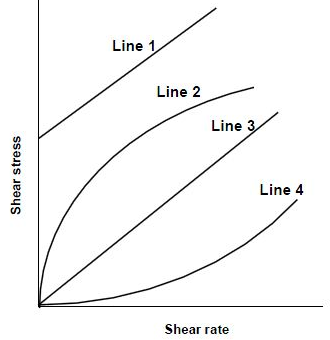
Refer to the shear stress – shear rate plot shown in the figure below. Match the lines (Column I) with appropriate rheological behavior (Column II).
Column I
P. Line 1
Q. Line 2
R. Line 3
S. Line 4
Column II
1. Dilatant
2. Newtonian
3. Pseudoplastic
4. Bingham plastic
A. P-2, Q-3, R-4, S-1
B. P-1, Q-3, R-4, S-2
C. P-2, Q-4, R-3, S-1
D. P-4, Q-3, R-2, S-1 correct
Q111NAT2 marks
Water flowing at a rate of 1 kg/min is heated from 12 to 80 °C with flue gas supplied at a rate of 3 kg/min. The temperature and specific heat of the flue gas are 180 °C and 1.05 kJ/kg.K, respectively. If specific heat of water is 4.2 kJ/kg.K and the flow is parallel, then the logarithmic mean temperature difference will be ______ °C.
Correct: 53.3 to 55.25
Q112NAT2 marks
The Lineweaver-Burk plot of an enzymatic reaction shows Vmax of 160 µmol/l.min and km of 60 µmol/l. For a substrate concentration of 40 µmol/l, the velocity of the reaction is estimated to be ____ µmol/l.min.
Correct: 64
Q113NAT2 marks
A suspension containing 2 × 10⁴ spores of organism A having a D₁₂₁.₁°C value of 1.5 min and 8 × 10⁵ spores of organism B having a D₁₂₁.₁°C value of 0.8 min is heated at a constant temperature of 121.1 °C. The heating time needed to obtain a probability of spoilage ‘1 in 1000’ is _______ min.
Correct: 10.8 to 11.2
Q114NAT2 marks
In an evaporation process, a compressor picks up 0.05 m³ air in each revolution and compresses 500 kg of air per minute. If the specific volume of air is 0.9 m³/kg, then the compressor speed is _________ rpm.
Correct: 9000
Q115NAT2 marks
For a soybean oil extraction system, solvent:soy ratio is maintained at 0.5:1 (w/w). Original seed contains 18% oil (w/w). If the meal (soy solid) after final desolventization has 0.01 kg oil per kg oil free meal, then the effectiveness of the solvent (kg oil/ kg solvent) in the extraction process is ________ .
Correct: 0.3 to 0.4
Worked solutions are not printed here — every one of these questions carries a
full explanation inside the test itself, which is where it is actually useful:
after an answer has been committed.
Sit the 2017 paper.