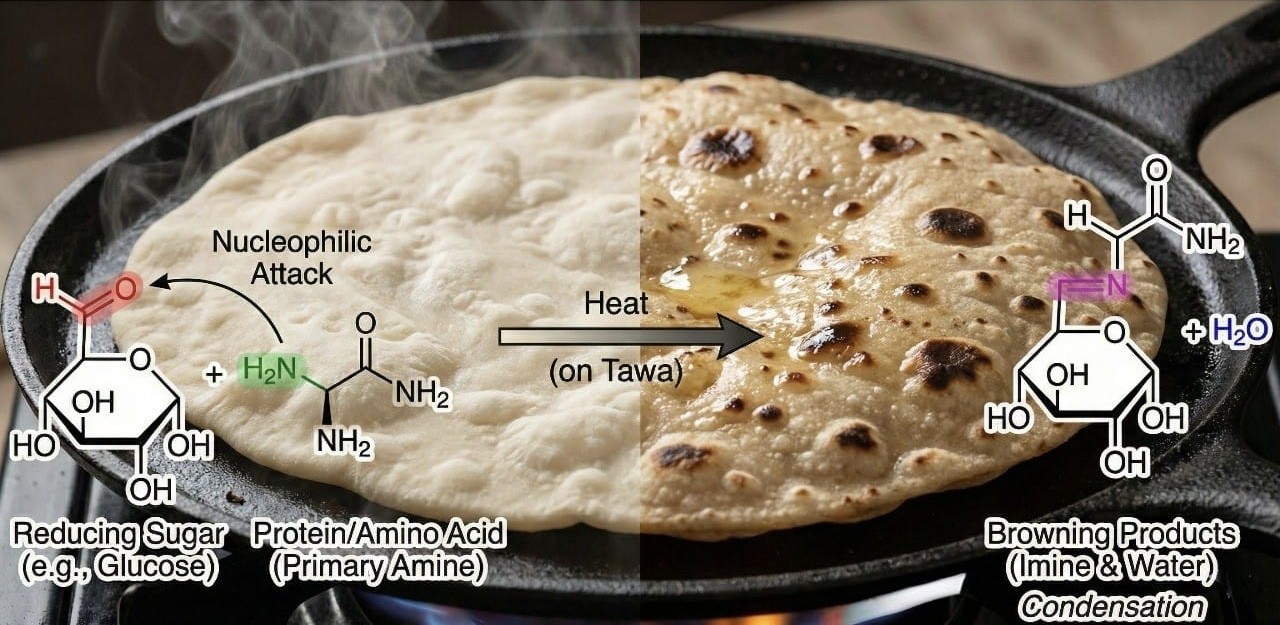
Have you ever wondered why pale, flavorless dough transforms into a golden, aromatic chapati the moment it hits the hot tawa? It isn't magic - it is a specific chemical reaction called the Maillard Reaction.
Phase 1: The Setup (The Ingredients)
The process begins inside your dough. Wheat flour provides two sleeping giants that usually ignore each other:
- Reducing Sugars: Simple carbs (like glucose) found in the starch.
- Amino Acids: The building blocks of proteins (like gluten).
At room temperature, they just sit there. But when you throw the rolled dough onto a tawa heated above 140°C (280°F), you provide the energy they need to wake up and collide.
The Concept
Protein + Sugar + Heat = Yum
Phase 2: The Attack (The Chemical "Hook-Up")
Once the heat is applied, the reaction kicks off instantly. As shown in chemical diagrams, the Nitrogen atom on the amino acid becomes aggressive (a nucleophile). It acts like a magnet and attacks the reactive Carbon atom on the sugar.
To seal this new bond, the two molecules fuse together and kick out a molecule of water (H₂O). This is called Condensation. The result is a temporary new molecule called an Imine.
Key Concept
Nitrogen Attacks Carbon, Water Exits.
Mnemonic
NACWE
Phase 3: The Transformation (The Browning)
The imine created in the previous step is unstable—it’s like a wobbly tower. It rapidly shuffles its atoms around (a process known as Amadori rearrangement) and breaks down into hundreds of chaotic new chains.
These chains polymerize (link up) to form large, complex brown pigments called Melanoidins. These pigments create the characteristic brown spots on the chapati, while smaller volatile molecules escape into the air, creating the toasted, savory smell that fills your kitchen.
Key Concept
Maillard Makes Many Melanoidins.
Mnemonic
MMMM
The Big Picture: Non-Enzymatic Browning
You might hear scientists call this process "Non-Enzymatic Browning." This is just a fancy way of separating cooking from rotting.
The "Rotting" Way
Enzymatic
When you cut an apple and it turns brown, that is biology. Biological tools (enzymes) inside the fruit react with oxygen. No heat required.
The "Cooking" Way
Non-Enzymatic
When you make a chapati, there are no biological tools used. The Heat alone forces the sugar and protein to smash together chemically.
The Golden Rule
"If it needs heat to turn brown and tasty, it is Maillard. If it turns brown on the counter by itself, it is enzymes!"